For farmers in the south-eastern plains of Kailali, the monsoon once arrived less as a blessing than a threat. Paddy transplanted with sweat and hope in June would often be washed away overnight by floods in August and September. The swollen Mohana, Kandra, Kandha, and Patharaiya rivers routinely swallowed entire harvests, leaving households struggling to keep their kitchens running.
That pattern, however, is beginning to change.
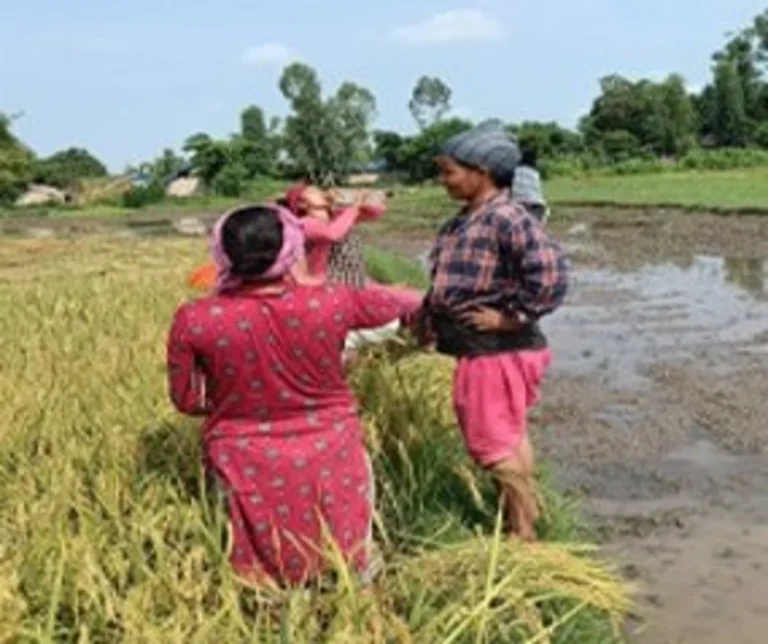
While farmers have not overcome floods, they have adapted to them. Across parts of Kailali, many have shifted their dependence to spring paddy (known as chaite dhan in Nepali), transplanted months earlier and harvested before peak monsoon flooding. The strategy is simple: harvest before the rivers rise.
Kailali remains one of Nepal’s most flood- and inundation-prone districts. Each year, floods displace thousands of families and damage crops. Unseasonal rainfall compounds the problem, often pushing communities into food insecurity. In response, farmers have begun transplanting paddy as early as March, adopting what agronomists describe as a form of climate adaptation.
The crop cycle begins with seedbeds prepared in late January. Within about 120 days, by early June, the paddy is ready for harvest. Farmers say yields are often higher than those of paddy transplanted during the monsoon.
The shift is most visible in Bhajani, Tikapur, Joshipur, and Kailari, areas historically hit hardest by floods. In Bhajani, wards 3 and 8 have even been designated as paddy zone areas due to the rapid expansion of spring paddy cultivation.
The transformation has altered local food systems. Farmers who once relied solely on wheat and purchased rice for consumption are now producing enough paddy to meet household needs and generate surplus for sale. The change has brought both economic relief and psychological security.
Punshi Lama, 50, from ward 8 of Bhajani Municipality, said spring paddy has helped her family avoid hunger. She has been cultivating the crop for the past four years. After setting aside enough for annual consumption, she sells the remainder. Last year alone, she earned Rs30,000 from paddy sales.
“Earlier, there was no practice of transplanting spring paddy. Monsoon crops would fail, and sometimes we had to go hungry,” Lama said. “Those who had money bought rice from the market. Those who didn’t suffer the most.”
Lama has lived with the threat of floods since the 1980s. She said flooding has intensified over time, causing greater damage to farms, homes and daily life.
Sitaram Dagoura, a farmer from ward 3 of Bhajani, recalls being ridiculed when he first began transplanting paddy during spring nearly two decades ago. He claims to be the first in the area to try the practice, starting with a local variety known as Munwa.
Dagoura said people initially dismissed him as irrational for transplanting paddy in March, insisting the crop was meant for June. He said some villagers even blocked irrigation to his field, forcing him to dig an underground channel to bring in water.
When the crop succeeded, scepticism turned into curiosity. Dagoura began distributing seeds to other farmers. Today, he cultivates paddy on about 8.5 bighas (5.75 hectares) of land and sells around 400 quintals last year.