About Us
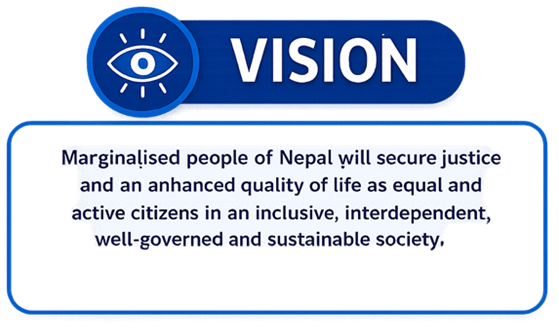
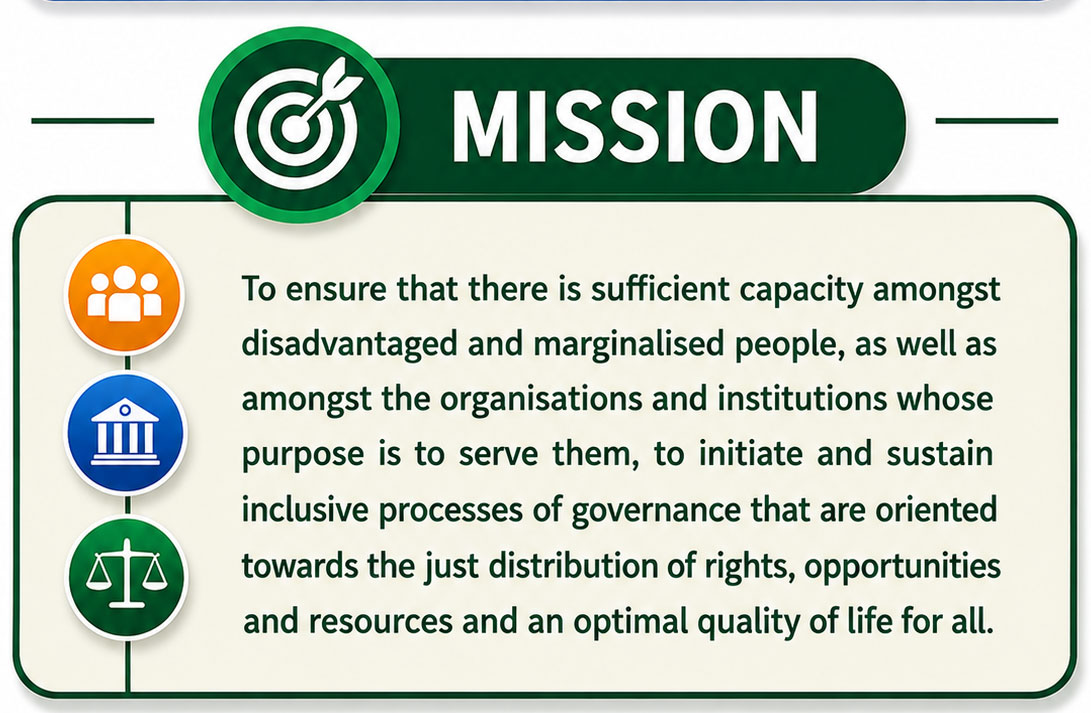
Sahakarmi Samaj (SS) is a national non-governmental organization established in 1997, committed to social transformation, empowerment, and inclusive development, with a strong focus on marginalized and disadvantaged communities. SS promotes sustainable, justice-oriented development by enabling communities to become self-reliant and actively engaged in local governance processes.
SS works across core thematic areas: (i) agroecology, livelihoods and economic empowerment, (ii) governance and social accountability, (iii) capacity building and facilitation, and (iv) gender equality and social inclusion (v) climate resilience and disaster risk reduction (vi) health and education.
At the heart of SS’s approach is its facilitative development model “Facilitation for Empowerment and Social Transformation (FEST)” which emphasizes participatory analysis, collective planning, local resource mobilization, and constructive engagement with government and non-government stakeholders. Through FEST, SS strengthens community institutions and local governments to collaboratively address the needs of vulnerable populations, particularly women and marginalized groups.
Over the years, SS has implemented this approach across 18 districts in Sudurpashchim, Karnali, Bagmati, and Lumbini Provinces. It has facilitated the formation of more than 3000 Community Development Groups (CDGs), along with their main committees and 25 Community-Based Network Organizations (CBNOs), local NGO, which are recognized by local governments as representative platforms of community voices.
SS has a strong track record of managing donor-funded programs and has received support from a range of international development partners, including the Australian Government Department of Foreign Affairs and Trade (through The Asia Foundation), Mercy Corps/USAID , the Practical Foundation, the European Union, Irish Aid (via SHEP Ireland), The Development Fund Norway, International Alert (with support from the U.S. Department of State), SIMAVI (Netherlands), FASTENAKTION (Switzerland), United Nations Development Programme (UNDP), ActionAid Nepal, Deutsche Gesellschaft of Internationale Zusammenarbeit (GIZ) on behalf of the German Federal Ministry of Economic Development and Cooperation, FHI 360, and various municipalities.
With its long-standing experience, strong grassroots networks, and proven facilitation model, SS is well-positioned to deliver impactful, sustainable, and locally owned development outcomes.
Recognized as a national-level resource organization for capacity building, SS operates the Sahakarmi Training and Research Centre (STRC) in Kohalpur, Banke, a dedicated infrastructure for residential training and professional development for NGOs, government officials, and development practitioners.
History
The history of Sahakarmi Samaj is linked with the Community Education Programme implemented by the United Mission to Nepal in Surkhet District more than two decades ago. The programme was helping marginalised people to experience the possibility of having meaningful developmental change through mutual support and collective action. As well as promoting the effective and sustainable use of local resources, the project served to enhance marginalised people’s capacity to advance just claims to external resources. In order to minimise dependency and to guarantee the long-term sustainability of the changes brought about through its work, the project sought to build the institutional capacity development of community and government authorities, which was the guiding principle of the organisation.
By the time the project was wrapping up in Surkhet in 1996, a team of staff had gained good experience and developed their capacity for independently running such projects, and decided to dedicate their time to the social cause. They decided to form the NGO Sahakarmi Samaj to empower the community to achieve the goal of social justice by empowering poor and marginalised communities. A management committee was established, which developed policies to give shape to the new organisation. Proposals were then developed for a new work programme, SAKTEE (Strengthening Awareness & Knowledge through Education for Empowerment) in Banke District, which was financially supported by some donors, including the Lutheran World Federation (LWF) and the United Protestant Churches in the Netherlands (UPCN). The SAKTEE Programme was delivered in two phases and concluded in 2007. Over this period, Sahakarmi Samaj also delivered 6 other programmes based on the FEST approach. FEST is a pioneering community empowerment initiative, which enables the community groups and institutions, as well as the local government, to work towards a more just and interdependent society through critically-informed collaborative action.
In 2006, Sahakarmi Samaj entered into a learning partnership with The Social and Health Education Project (SHEP), an Irish NGO. Through this partnership, in 2007, Sahakarmi Samaj was able to avail funding from the Irish Aid Civil Society Fund, which, in combination with funding from UPCN (by then operating as ICCO-Kerk in Actie), allowed it to establish a successor to the SAKTEE Programme: The South Western Nepal Community Governance Enhancement Programme (SWNCGEP). Between 2007 and 2016, this programme continued in three phases (two phases in Bardiya and Kanchanpur Districts and one phase in Kailali and Jajarkot Districts). A parallel programme, the Community Governance Enhancement for Social Transformation Programme (CGEST), was also delivered in two phases in Dang District with funding support from ICCO-Kerk in Actie. In addition to this, six other similar programs, especially related to organisational development, human rights, peace and reconciliation, and community governance, were delivered alongside SWNCGEP and CGEST with funding support of ICCO-Kerk in Actie, Mercy Corps/USAID, the Practical Foundation, and the Development Fund Norway.
From the onset, Sahakarmi Samaj provides training for personnel of national and international NGOs, and the organisation’s training work has continually become stronger to the present day. Similarly, the organisation has been part of different networks of national and international non-governmental and civil society organisations for raising the local issues at the local, provincial, and federal levels for creating a just society. The organisation aims to create a just society where all people, especially poor and marginalised communities, enjoy their rights without any hindrance.
Purview Statement
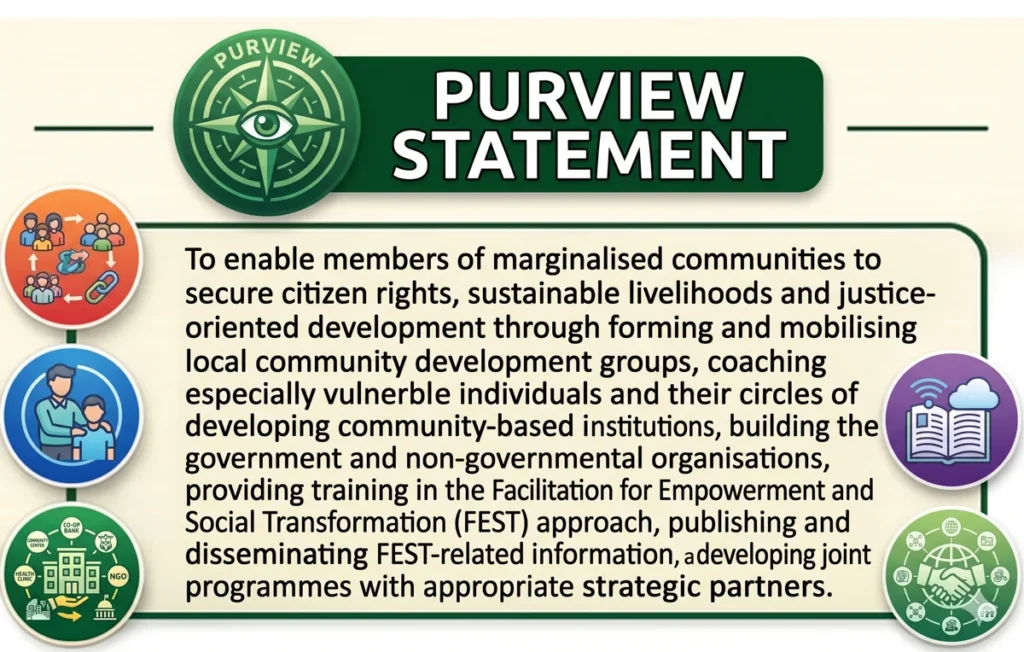
To enable members of marginalised communities to secure citizen rights, sustainable livelihoods and justice- oriented development through forming and mobilising local community development groups, coaching especially vulnerable individuals and their circles of support, developing community-based institutions, building the capacity of government and non-governmental organisations, providing training in the Facilitation for Empowerment and Social Transformation (FEST) approach, publishing and disseminating FEST-related information, and developing joint programmes with appropriate strategic partners.
Core Value
There should not be injustice in the community in the name of peace building. We Sahakarmians are committed to creating an appropriate environment for disadvantaged and marginalised people to build their capacity, to make them free from any kind of injustice, exploitation, oppression or pain.
Every individual has inner potential that can be developed, given an appropriate environment. We are always committed to providing support in order to bring out a person’s potential.
An individual has a fundamental right to live with dignity and respect. We are committed to developing a culture of utilizing your own rights and performing your duties without violating others’ rights. Therefore, we are committed to making disadvantaged and marginalised people aware of their fundamental rights and duties. We ourselves also need to be aware of our rights and duties.
(recognizing that human wellbeing is a collective as well as a personal achievement): Any individual or community cannot be self-dependent for everything. Skills, knowledge, experiences and any other resources that an individual may have should be shared. This kind of sharing will increase mutual co-operation and work efficiency i.e. interdependency. We emphasize the development of this interdependent relationship, in order to strengthen the relationship among the community people, their respect for each other and the opportunities to ensure an optimal quality of life.
We believe in proper personal attitudes. Integrity brings efficiency in the work of an individual. We give a high priority to maintaining the economic, social and ethical discipline to take responsibility for oneself and to use available resources appropriately while performing our duty.
We strive for mutual co-operation, by respecting each other’s thoughts, feelings and values, inspired by friendship and respectable behaviour. We are committed to creating an appropriate environment of forgiveness, to learn from our own experiences and to support others to learn, by analysing past weaknesses while performing our duties.
The governance process should be effective and strong to make any community and organisation more effective. We are committed to developing a more systematic method of working and an appropriate level of responsiveness, accountability and transparency within our own organisation and within those communities and organisations where we are working. We make them aware about an appropriate governance system and support them to develop good governance as a culture of the organisation.
We treat all individuals equally rather than discriminating against or treating them unfairly, based on their thoughts/beliefs, caste, gender, race, religion, culture or community. In particular, we are committed to ensuring that we do not discriminate, on the basis of the above criteria, while providing any opportunities or distributing resources in disadvantaged and marginalised communities.
- We are very sensitive to our natural resources, cultural assets and bio-diversities. Our activities should not cause any destruction to our natural resources and cultural assets. We are committed to the protection, development and promotion of our natural resources and the cultural values of specific local languages, cultures and customs.
Who we are
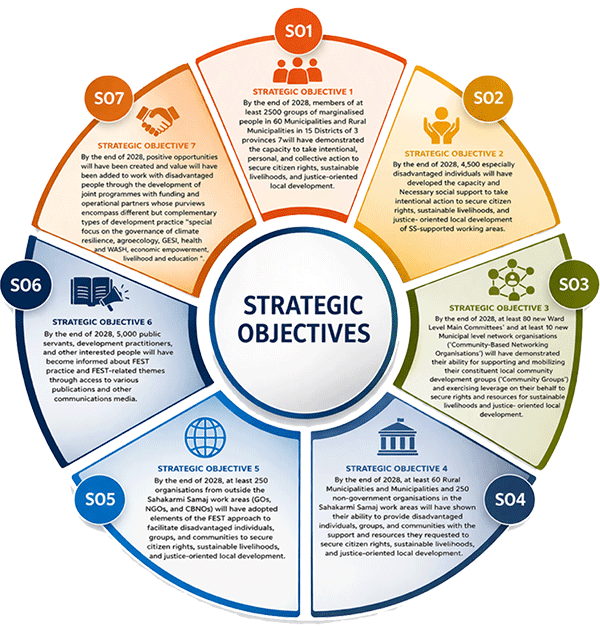
Strategic Objective