
The FEST Approach: SS’s Facilitation Philosophy
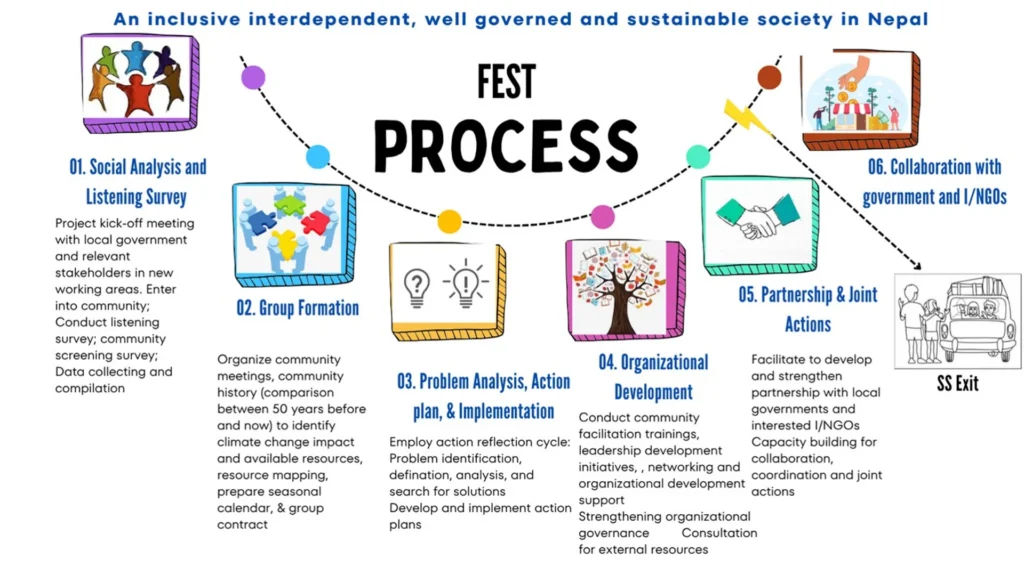
At the heart of SS’s approach is its “Facilitation for Empowerment and Social Transformation (FEST)” model, which emphasizes participatory analysis, collective planning, local resource mobilization, and constructive engagement with government and civil society stakeholders.
FEST does not provide a blueprint to be directly replicated in all situations. Instead, it suggests a range of understandings, values, and principles that must be respected in the design and implementation of programs designed to bring about empowerment of the marginalised and wider transformation in society. What follows are the outlines of two proven applications of the FEST approach: the Surkhet Project Awareness Raising Cycle (SPARC) and Sahakarmi Samaj’s Community Governance Enhancement for Social Transformation (CGEST) program.
Stage One: Social Analysis and Listening Survey
- To establish trusting relationships with community members in the area.
- To identify the most marginalised communities and groups in the area.
- To identify the actual interests and concerns of these marginalised groups.
This stage is of about 6 months’ duration. During that time, the field staffs (a team of six community educators in each Rural Municipality or Municipality) conduct meetings with Municipalities or Rural Municipalities to introduce the program process and to secure official invitation from the local level. The Sahakarmi Samaj field team conduct Community Screening Process (CSP) meetings in different parts of each ward of the selected Rural/Municipality and the use of participatory exercises to identify the most marginalised communities and the reasons for their marginality. Based on information from the CSP meeting, the team conduct reflection on and analysis of the situation of the respective communities and identification of the key issues affecting them. They also conduct the selection of possible communities to work with. For this, a list is prepared of marginalised communities within each ward under the Rural Municipality or Municipality.
The Sahakarmi team visit every household in the selected communities to establish contact and explain the purpose of Sahakarmi Samaj. Details of these visits are documented, identifying any factors of disadvantage and critical issues affecting individual families. Having familiarised themselves in this way with the locality and its people, they perform a social analysis through which the most disadvantaged and marginalised communities or groups are identified. Further visits are then made to these marginalised communities/groups to strengthen the relationship with them. Their actual interests and concerns (known, in Freirean terms, as `generative themes’) are identified using the `listening survey’ technique. This is a kind of participant observation method in which field staff note and record the issues that are most important to the villagers.
Stage Two: Group Formation
The broad objectives of stage two are:
- To establish community groups (or links with existing groups).
- To develop common understanding among community group members of their role and responsibility.
- To develop the skills needed for effective group working.
- To develop the group contract.
This stage is of about 2-3 months’ duration. Unless a group has already been formed, field staff first bring community members together into a group, giving special encouragement (and reassurance) to the most marginalised. During this stage, Community Educators (CE) explain the Sahakarmi program approach and ask them for their full participation for later years. After the program orientation session, the community educators facilitate using participatory tools on group concept, community vision, seasonal calendar, development trend analysis of past years, resource analysis etc. After several meetings, a `group contract’ is established with the group which includes the basic guidelines for effective group interaction. Facilitators provide feedback with their observations of group behaviour with reference to the contract. At this stage, the group members are encouraged to make their own guidelines.
Stage Three: Problem definition, Action Planning and Implementation
The broad objectives of stage three are:
- To develop the capacity of group members to critically analyse problems and identify root causes.
- To identify root problems for group action and determine a common goal in relation to the group’s root problem.
- To identify strategies, resources to implement objectives to meet the goal.
- To formulate an appropriate action plan, evaluate the outcome and to define a new goal.
In this stage, the educators conduct weekly meeting in the selected community. At each meeting a different concern (generative theme) is addressed using a problem-posing tool known as a ‘code’. A code may be a play, a mime, a role-play, a picture, a photo, a puppet show, a story, a song, a game, somebody’s personal history, a field visit; anything which brings the problem into sharp focus. The code does not provide any answers. In the course of group discussion, the facilitator steers the group through the 6 steps of problem analysis in line with the Freirean method:
- Description of the code (What did you see? What happened then?)
- First analysis (Why do you think he behaved in that way? Why does the girl in the picture look sad?)
- Real life (Does that ever happen here? Do you have any experience of this?)
- Related problems (What happened to his family? How does that affect the community?)
- Root causes (Yes, but why? I see, but why? But why does that happen?)
- Action (What can we do about it? How could we change that?)
In this way the group members are encouraged to think through the problem, identify its root causes (the ‘root problems’) and come up with their own answers. Some groups may be impatient to take action to address a certain root problem and in this case the facilitator may decide to proceed immediately on to stage three, the action stage. Otherwise, towards the end of stage two, the group will have to consider all the root problems it has uncovered and decide which of these, if any, it wants to address first. At this point it may be that certain specific interest groups break away from the original groups. However, the facilitators will generally encourage groups to continue to work together to address common community concerns.
This stage is of variable duration, depending on the nature of the problem being addressed. In the first instance, facilitators encourage groups to address a small-scale problem, using only locally available skills and resources. More ambitious projects may be initiated once the group is familiar and confident with the process, although the emphasis remains throughout on the creative utilisation of local skills and resources.
Firstly, the group decides on a goal for its action. If the problem addressed is very complex or abstract, facilitators help the group to conduct a `force-field analysis’; a tool used to identify manageable goals. Strategies are then identified by `brain storming’ and group discussion. At this stage, it may be realised that the group lacks adequate information, skills or resources to meet its goal. In such a case, the root problem is redefined as a lack of information, skills or resources, and a new goal is set to resolve this problem. The facilitator may then help the group to enhance its knowledge and skills through the use of appropriate participatory research methods. The community members may be assisted to undertake necessary investigation through sponsored consultation with resource persons, trainings and study tours.
The facilitator helps the group to determine objectives in relation to its chosen strategy. Pictures are generally used to represent the objectives in order to make it inclusive to those with limited or no literacy skills. The facilitator helps the group to formulate an action plan, detailing who is responsible for individual tasks and when and where these should be carried out. Again, pictures or agreed symbols are used to represent the tasks on the group action plan.
One task that is always listed is that of monitoring the implementation of the plan, the responsibility for which is assigned by the group to certain members. The facilitator helps the group members to conduct an evaluation discussion, reflecting openly on the outcome of their actions and drawing out the lessons to be learned from their experience. Depending on the outcome, group members may decide either to define a new goal in relation to the same (unresolved) problem or to tackle a completely different problem and the action and reflection cycle goes on as a regular schedule of the community.
Stage Four: Organisational Development
The broad objectives of stage four are:
- To develop leadership skills among group members.
- To provide organisational development support and consultation to Community Based Organisations and Community Based Network Organisations.
- To establish networking among community groups.
- To develop linkages, coordination and collaboration with government and other service providers.
- To strengthen local resource exploration, mobilisation and acquire external resources.
- To enhance community advocacy for addressing their issues
If a group that has successfully achieved at least 4-5 goals decides that it wishes to establish itself as an ongoing institution (a CBO) it may participate in stage four of our programme. The project offers series of leadership trainings for group representatives for developing skills such as facilitation, institutional development, and planning, record-keeping and financial management. Leadership development training includes the provision of a) Community Group Strengthening Training (CGST), b) Community Facilitation Training (CFT), and c) Community Organisation Strengthening Training (COST). CGST covers issues such as group work, participation, decision making, roles and responsibilities, and development theory. CFT covers facilitation skills, leadership and meeting management. COST covers network formation, resource acquisition and liaison with external agencies. COST supports the emergence of network organisations at a) Rural Municipality or Municipality level, and b) regional (sub-district) level. Sahakarmi Samaj’s Organisational Capacity Building and Training, Consultation and Research Sections provide support and specialist training in accordance with the specific needs of established network organisations.
During this stage Sahakarmi Samaj also provides support to the local government and facilitates workshops to raise awareness amongst local representatives and government officials regarding social marginalisation injustice, good governance and democratic accountability. Interaction meetings between local level government and CBOs are conducted to strengthen effective service delivery process by the government.
Sahakarmi Samaj also offers free organisational development consultancy to these groups, both in project office and, as necessary, in the field. Similarly, issue related workshops are conducted among the groups with similar issues and support is given to carry out the collective action plans to achieve the collective goal.
At the end of the fourth year, the Sahakarmi team of Community Educators conduct the participatory assessment of community group capacity at the point of withdrawal by the community educators. However, the team provide continued backstopping support through regular capacity assessment of the community groups and network organisations using participatory self-assessment tools.
Stage Five: Partnership and Joint Actions – Expanding Horizons and Building Alliances
The Facilitation for Empowerment and Social Transformation (FEST) process, pioneered by Sahakarmi Samaj, is built upon a profound truth: long-term, transformative change only happens when marginalized groups design their own path forward. Rather than relying on temporary external aid, the FEST framework guides grassroots organizations from initial dependency toward full, sustainable interdependence.
As communities progress into this Partnership and Joint Actions stage they undergo a profound narrative shift. They transition from focusing on internal growth to establishing external, institutionalized power.
Before reaching this phase, community groups spend considerable time looking inward. They hold meetings, build local leadership, and discover their collective voice. However, a turning point occurs when they realize that the systemic barriers keeping them in poverty cannot be solved alone. Complex challenges, such as climate vulnerability, poor infrastructure, and deep-seated social exclusion, require a broader front.
In Stage 5, the community intentionally shifts its gaze outward. They begin identifying external networks, neighbouring groups, and local institutions that share their vision. The primary goal of this stage is to build mutual trust, break down isolation, and construct a web of regional partnerships.
Practical Step-by-Step Implementation
- Conducting Shared Priority Mapping: Community groups sit down to identify local government bodies, cooperatives, and community-based networks operating in their region. They analyze what these external entities care about, looking for overlapping goals.
- Initiating Regular Stakeholder Dialogue: Instead of waiting for a crisis, the community hosts routine, informal roundtables and interactions. These meetings are designed to break the ice, align expectations, and slowly plant the seeds of organizational trust.
- Targeted Technical Skill Acquisition: To engage professionally with larger entities, community members undergo intensive training in technical skills. They learn how to write formal proposals, coordinate multi-party efforts, and negotiate effectively without losing their core values.
- Formulating Guidelines and Governance Policies: The group establishes clear, written internal policies and strategic guidelines. This step ensures they have an institutional framework that protects their interests during joint ventures.
- Cultivating Team Culture and Solidarities: Internal workshops are conducted to reinforce a healthy, collaborative team culture. This keeps group members aligned, prevents internal conflicts, and prepares them to act as a unified front.
The Role of Sahakarmi Samaj
At this juncture, Sahakarmi Samaj steps back from direct organizing and adopts the role of an institutional coach. The field staff focus entirely on mentoring the group through complex stakeholder dynamics, providing guidance on policy formulation, and polishing their negotiation and proposal-writing skills.
Realized Impact and Outcomes
The community experiences a powerful surge in confidence. They no longer view themselves as passive victims of their circumstances, but as legitimate local actors. By working with others, they achieve infrastructure improvements and social support systems that would have been impossible to secure independently.
Stage Six: Collaboration with Stakeholders: The Apex of Sustainability
Stage 6 represents the graduation and ultimate destination of the FEST process. The narrative shifts from building temporary alliances to systemic integration and total self-reliance. The community groups and their broader networks are now mature, sophisticated organizations.
They no longer rely on an NGO to set their meetings or speak on their behalf. Instead, they step directly into municipal halls, look local authorities in the eye, articulate their developmental needs, and hold public service providers accountable for their budgets.
Practical Step-by-Step Implementation
- Direct Civic Advocacy and Accountability Audits: The community group schedules regular, direct meetings with government officials and international NGOs. They clearly present their development aspirations and establish citizen-led tracking mechanisms to ensure public funds are spent transparently.
- Active Inclusion in Local Budgeting Cycles: Community leaders independently show up at ward and municipal planning sessions. They do not wait to be invited; they strategically use their numbers and influence to ensure that municipal budgets explicitly fund projects for marginalized areas.
- Scaling Partnerships Globally and Nationally: The networks directly approach national and international NGOs. They bypass local middlemen to secure advanced technical innovations, capacity-building resources, and direct financial grants.
- Navigating the Structural Phased Exit: The community works alongside the facilitation agency to execute a seamless transition plan as the external NGO (Sahakarmi Samaj) prepares to close its local office.
The Role of Sahakarmi Samaj
This stage marks the gradual, deliberate withdrawal of Sahakarmi Samaj from direct facilitation. To prevent any long-term dependency, the organization steps completely out of the picture. Its job is done because it leaves behind a resilient, capable institutional infrastructure that will endure for generations.
Realized Impact and Outcomes
The ultimate goal of the FEST process is fully realized: a community that owns its own future. Permanent, healthy relationships are established between elected representatives and citizens. The community operates as a fully independent entity, capable of managing its own development long after the donor-funded program has moved on.